
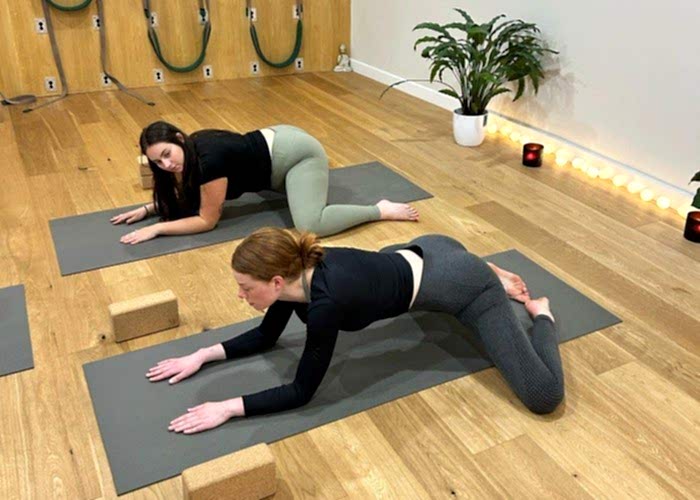
How the functional approach to yoga respects your unique body
When you step into a yoga class, what do you imagine? Rows of beautiful bodies folding neatly into identical shapes? Perfect postures? Alignment so flawless it could grace the cover of a magazine?
If that’s the image, it’s no wonder many people feel intimidated or frustrated by yoga. But at SPACE, we believe that real yoga isn’t about looking a certain way – it’s about feeling better in your own unique body. And that’s exactly why we love the functional approach.
In this post, we dive into what the functional approach to yoga really means, why it’s so important to respect your unique anatomy, and how it could be the game changer you didn’t even know you were looking for.

What is the functional approach?
The functional approach to yoga is all about understanding and honouring the fact that no two bodies are the same. Rather than aiming for an aesthetic ideal – toes touching the floor here, arms perfectly aligned there – the focus is on the function of the pose.
In short: what matters is how you feel, not how you look.
As Paul Grilley, a pioneer of the functional approach, so beautifully explains, the ultimate limit to every range of motion is the bones. Your bones are unique to you – their shape, their length, their orientation – and they determine how a pose feels and where your body can safely and naturally go. No amount of stretching or “pushing through” can change your bone structure!
And at SPACE, this philosophy underpins everything we do – from our regular classes to workshops and retreats.
Why skeletal variation matters
If you’ve ever wondered why your Downward Dog feels so different from the person next to you, or why your knees are always way off the ground in Butterfly Pose while your neighbours’ are flat, the answer often lies in skeletal variation.
Skeletal variation refers to the natural differences in the shape, size and orientation of our bones. For example, one person’s hip sockets might be deep and narrow, another’s wide and shallow. These differences have a huge impact on how your body moves and feels in different poses. As Paul Grilley would say, this means that “what is easy for one skeleton is impossible for another”.
In our classes, you’ll often hear Dee saying, “Every body is different.” And she really means it. We work with what you have, guiding you to find your version of a pose rather than striving to match someone else’s.

Saying goodbye to the ‘perfect pose’
The traditional model of yoga teaching has often revolved around rigid alignment rules and the pursuit of perfect shapes. But this can create unrealistic expectations – and worse, sometimes even injury or emotional harm.
Have you ever felt disheartened because you couldn’t get your heels to touch the floor in Downward Dog after years of practice? Or wondered why your hips just won’t sink in Child’s Pose?
The functional approach invites you to let go of these pressures. Instead of forcing your body to fit a pose, you adapt the pose to fit your body.
Imagine how freeing it feels when you stop chasing a shape and start listening to what feels right. That’s what real yoga is all about.
The emotional impact of embracing your body
One of the most beautiful parts of the functional approach is how it supports emotional healing as well as physical wellbeing.
By respecting your unique anatomy and releasing attachment to external ideals, you start building a much healthier relationship with yourself. You move from a mindset of “I’m not good enough” to “I’m exactly enough.”
Dee has seen countless students experience powerful shifts when they realise they no longer have to “achieve” a certain pose. The joy and relief of giving yourself permission to be where you are is truly transformative.

How we teach the functional approach at SPACE
At SPACE, the functional approach is at the heart of our teaching.
Every class you attend will offer:
- Options and variations based on your unique structure
- Explanations about why certain poses might feel easy or difficult
- Support to find the shape that feels best for you
- Permission to honour your body’s natural limits without judgment
Dee also mentors new teachers to ensure this approach is woven throughout our classes. We believe yoga should be a place of healing, self-acceptance and personal growth – not a performance.
If you’re curious to explore this further, you might enjoy our previous post The functional movement approach to yoga, where we talk more about skeletal variation and how to adapt poses safely.
It’s time to rethink alignment
Is strict alignment always the safest or best option? According to the functional approach, not necessarily.
When teachers insist on one-size-fits-all alignment without considering individual bones, it can cause strain or discomfort. Instead, alignment should be functional – designed to help you feel the stretch, strength or release in the target area, while keeping your body safe.
That’s why you’ll often see students in Dee’s classes looking quite different from one another – and that’s absolutely the point! No two skeletons move exactly the same way.

Building a more inclusive yoga world
We believe that the functional approach holds the key to making yoga more inclusive, accessible and sustainable for all bodies.
You don’t have to be super flexible, young, slim or strong to practise yoga. You simply have to show up as you are. And when the focus is on function rather than form, everyone can experience the true benefits of yoga – more space in the body, a calmer mind and a deeper sense of connection to self.
This is the ethos that inspired the creation of SPACE: to offer a welcoming environment where yoga truly is for every body.
Making space for you
The functional approach isn’t just a method. It’s a mindset.
It’s about respecting your individuality, embracing your body and finding freedom rather than frustration on the mat. It’s about making space – physically, mentally and emotionally – to be fully yourself.
So, next time you roll out your mat, remember: your yoga is unique because you are unique. And that’s not just OK – it’s beautiful.
If you’re ready to experience the functional approach for yourself, why not join us for a class at SPACE? We’d love to welcome you.